Saturday, June 6, 2020

Radar Defense Part 4

For this article in the radar defense series the focus is run fits. These fits are all examples from the book and are diagrammed against Defense 1.


For these run fits the discussion will use terms from the book like F2 or B2. The F's are the front side or play side defenders while the B's are back side defenders.

Over the Center:


Fold Scheme

F1: Fill ready to play fold or crossblock
F2: Fan/Fan - Eyes inside when OT fans, cross the Fan of OG
F3: Fan/Fan - Eyes inside when TE fans, cross the Fan of OT
F4: Force
B1: Down by Center, cross the block
B2: Cutoff - Play lateral keep leverage on OT
B3: Cutoff - Play lateral keep leverage on TE
B4: Cutback

Trap Scheme

F1: Fill ready to play trap block
F2: Fan/Fan - Eyes inside when OT fans, cross the Fan of OG
F3: Fan/Fan - Eyes inside when TE fans, cross the Fan of OT
F4: Force
B1: Down by Center, cross the block
B2: Pull by OT, cross the back block by the OG
B3: Cutoff - Play lateral keep leverage on TE
B4: Cutback

Over the Guard:

Fold Scheme


F1: Down by the OG, cross the block
F2: Fan/Fold - Eyes inside when OT fans, ready to play fold block
F3: Fan/Fan - Eyes inside when TE fans, cross the Fan of OT
F4: Force
B1: Cutoff - Play lateral keep leverage on OG
B2: Cutoff - Play lateral keep leverage on OT
B3: Cutoff - Play lateral keep leverage on TE
B4: Cutback

Trap Scheme


F1: Down by the OG, cross the block
F2: Fan/Trap - Eyes inside when OT fans, ready to play trap block
F3: Fan/Fan - Eyes inside when TE fans, cross the Fan of OT
F4: Force
B1: Down by the OG, cross the block
B2: Cutoff - Play lateral keep leverage on OT
B3: Cutoff - Play lateral keep leverage on TE
B4: Cutback

Over the Tackle:

Fold Scheme


F1: Cutoff - Play lateral keep leverage on Center
F2: Down - Cross the block
F3: Fan/Fold - Eyes inside when TE fans, ready to play fold block
F4: Force
B1: Cutoff - Play lateral keep leverage on OT
B2: Cutoff - Play lateral keep leverage on OT
B3: Cutoff - Play lateral keep leverage on TE
B4: Cutback

Trap Scheme


F1: Down by OG, Cross the block
F2: Down - Cross the block
F3: Fan/Trap - Eyes inside when TE fans, ready to play trap block
F4: Force
B1: Down by Center, Cross the block
B2: Cutoff - Play lateral keep leverage on OT
B3: Cutoff - Play lateral keep leverage on TE
B4: Cutback

Over the End:


Fold Scheme

F1: Cutoff - Play lateral keep leverage on Center
F2: Pull/Cutoff - Play lateral keep leverage on OG
F3: Down - Cross the block
F4: Force
B1: Cutoff - Play lateral keep leverage on OG
B2: Cutoff - Play lateral keep leverage on OT
B3: Cutoff - Play lateral keep leverage on TE
B4: Cutback

G Scheme


F1: Cutoff - Play lateral keep leverage on Center
F2: Down - Cross the block
F3: Down - Cross the block
F4: Force
B1: Cutoff - Play lateral keep leverage on OG
B2: Cutoff - Play lateral keep leverage on OT
B3: Cutoff - Play lateral keep leverage on TE
B4: Cutback


With a Block by the Back:

Zone 

F1: Cutoff - Play lateral keep leverage on Center
F2: Cutoff - Play lateral keep leverage on OG
F3: Down - Cross the block
F4: Force
B1: Cutoff - Play lateral keep leverage on OG
B2: Cutoff - Play lateral keep leverage on OT
B3: Cutoff - Play lateral keep leverage on TE
B4: Cutback

Power


F1: Down by OG - Cross the block
F2: Down - Cross the block
F3: Down - Cross the block
F4: Force
B1: Down by Center - Cross the block
B2: Cutoff - Play lateral keep leverage on OT
B3: Cutoff - Play lateral keep leverage on TE
B4: Cutback

Around the End:

Onside Guard Pull


F1: Cutoff - Play lateral keep leverage on Center
F2: Down - Cross the block
F3: Down - Cross the block
F4: Force
B1: Cutoff - Play lateral keep leverage on OG
B2: Cutoff - Play lateral keep leverage on OT
B3: Cutoff - Play lateral keep leverage on TE
B4: Cutback


Offside Guard Pull 

F1: Down by OG - Cross the block
F2: Down - Cross the block
F3: Down - Cross the block
F4: Force
B1: Down by Center - Cross the block
B2: Cutoff - Play lateral keep leverage on OT
B3: Cutoff - Play lateral keep leverage on TE
B4: Cutback

Overall the fits are easy to understand when you follow the block reaction rules for the ON the LOS and OFF the LOS defenders laid out in the book. The front structure makes it difficult to get a double team effectively turning every scheme into a series of 1 on 1's. The main takeaways I had from looking at these fits is the critical nature of making a quick read of the block for the defender as well as the ability of the defender to cross down blocks or leverage cutoff blocks. Additionally many of the schemes quickly become "same as" for the defenders. While their reads and reactions are critical is seems likely they will be getting many reps of doing those limited number of reads and reactions. Repetition breeds mastery.

I could see how this type of lateral read and react style of defense could cause headaches for blocking schemes. The defenders don't try to go toe to toe and win with physical dominance. They are small quick stand up players who read and go where the blocking scheme doesn't want them to be. Combine lateral techniques with the alignments making double teams unlikely and the result is limited movement by the OL blocking at the point of attack. It also seems likely this scheme could marry nicely with some more aggressive calls that do have attacking penetrating defenders. In that case the blocking would have two very drastically different styles being threatened by the defense. The resulting challenge is the offense being forced to react post-snap if it is a read/react defense or attack/penetrate defense. It is always good to turn the supposed initiators (offense) into reactors. 

In the next article the focus will be usage, when to use which defense including some strength and stress areas of each call outlined in the book as well as adjustments.

Thursday, June 4, 2020

Split Back Load Option vs. Odd Front Defenses

Here is Carson-Newman running split back load option vs. two odd front structures.


The defense is in a 3-4 with the LB's bumped to crate a 3-3 spacing. 


The fit here is the OLB (9 Technique Sam) is slow playing the QB with the stack LB (Mike) the crack and load blocking scheme gets both the force safety and the corner blocked. The stack spacing makes the angle for the TE to get to the Stack LB difficult. The TE's angle ends up cutting off the middle LB in the stack.The QB does a good job of attacking the OLB and pitching late. The QB's attack of the edge helps hold the OLB and Stack LB. 

The next look the spacing is a 3-4 with a coverage rolled strong to a 1 high.

The OLB tries to slow play and widen to play the inside of the pitch late with the safety playing force outside the pitch. The TE now has an angle on the ILB. The QB does a great job of pressing the edge. As the OLB widens the QB keeps. The TE seals the ILB and the load block of the A back handles the safety. Really nice path of hash-numbers-sideline by the QB to take the most efficient angle. 


Good stuff running split back load option from the Eagles.

Radar Defense Part 3

Part 3 of the series on radar defense will focus on the block reactions for the off the LOS defender. 


For these examples the 1 player in Defense 1 will be featured however the off the LOS technique can be played by the 1,2, or 3 player depending on call or multiple numbers in the combination calls. The 1 player in Defense 1 is keying both the Guard and Center.

Down:


If either the Center or Guard attempts to block the 1, the 1 player will block shed playing immediately across the block filling any open seam that shows while pursuing laterally.


Both the Center and Guard may be down blocking in the same direction, the reaction for the 1 player does not change.


Against a down and pull scheme the 1 player will react to the down and cross the down block. 

Cutoff/Reach:


If the Center and Guard attempt to go flat and lateral to cutoff/reach the 1 player, the 1 player will play lateral down the LOS maintaining on the block.


The 1 player's reaction is the same if the block is in combination with a pull by either the Center or Guard.

The 1 player must be able to identify he angles of the Center/Guard block. The Cutoff/Reach is flat and lateral while the Down blocks are at an angle and coming toward him.

Fill:


When the Center and Guard block opposite one another the gap is open and the 1 player will fill. The 1 player will position himself in the inside area of the gap at the LOS ready for the blocking threat.


On the fill read the 1 player may get at a fold or trap puller from the inside. 


The 1 player may also get the fold or wham block with a trapping puller coming from the outside. 


The 1 player may also get a lead/isolation block from a back. 


When the 1 player positions himself at the LOS on a fill read he must anticipate the blocks in the order they will arrive. The fold schemes with pullers from the inside or outside from adjacent OL will arrive first, next the longer trap blocks coming from puller aligned further away,and lastly the lead block of a back.

Pass Set:


The 1 player will drop into coverage when the Center/Guard pass set. It is possible the off the LOS player may have pass rush responsibility on the pass set.

Those are the reads for the off the LOS players. In the next article the on the LOS and off the LOS techniques will come together for run fits against a full offense run blocking scheme.

Wednesday, June 3, 2020

Radar Defense Part 2

In part 2 of the series on the radar defense the focus is on the block reactions for the on the LOS players.


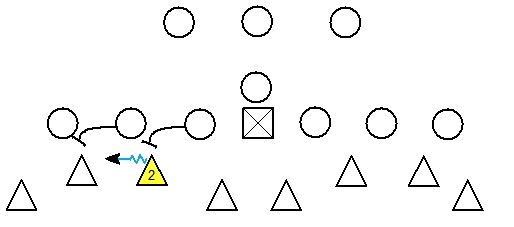
For these examples the 2 player in Defense 1 will be featured however the LOS technique can be played by the 1,2, or 3 player depending on call. The 2 player in Defense 1 is keying the OT.

Down Block:


When the OT blocks down the 2 player will block shed playing immediately across the block filling any open seam that shows while pursuing laterally.


The reaction is the same against a down and pull scheme.


Additionally if the down block is part of a double the 2 player will turn the double team into a single block and play immediately outside the OT's down block. Double teams are very difficult against this defensive alignment with all defenders near the LOS and in every gap.

Fan:


When the OT key blocks at an angle outside the 2's eyes and footwork must go back inside. The 2 player must be ready for a number of outcomes when reacting back inside.


The 2 must be ready for a lead/isolation block from a RB. 


When the 2 reacts inside he must also be ready for a trap block. 


Against a trap scheme when the OT punches the 2 and releases the 2 will use the same eyes inside step inside reaction.


The 2 will be at a disadvantage against a fold or wham scheme with the trap block coming from the outside.


Against a fan/fan scheme the 2 will react inside when the OT fans. With the OG also fanning the 2 will block shed and play immediately laterally across the OG's block. This technique is the same as the reaction to the OT's down block only working inside instead of outside. 


The book doesn't specify being read at the 2 position when the OT fans in an option scheme. Based on the rest of the reactions I believe the 2 would play hard inside and tackle any dive threat.


Cutoff/Reach:


If the OT attempts to go flat and lateral to cut the 2 player off on play away, the 2 player will play lateral down the LOS maintaining inside leverage on the cutoff block.


When the OT is flat and lateral outside the 2 player must be flat and lateral to maintain leverage on the OG. The 2 player must be able to ID the angle difference in a Fan and Reach.

Pull:


When the OT pulls inside  (long pull or a fold) the 2 player reacts flat and lateral inside. The 2 will block shed and play across the block of an interior OL blocking back on him.


Against an outside pull the 2 will play outside. The outside movement should help the 2 player avoid a reach from the OG. The 2 can either get in the pullers hip pocket and chase behind the LOS or play laterally based on the body position he ends up in in relationship to the puller and LOS.

Pass Set:


When the OT pass sets the 2 will pass rush. It is possible in some defenses the LOS player may have a pass drop responsibility when the key pass sets.  

Those are the block reactions for the on the LOS player. The next article will feature the off the LOS player reads. 

Monday, June 1, 2020

Radar Defense Part 1

This series of posts on the radar defense is based off the 1969 book "The Radar Defense for Winning Football" by Jules Yakapovich


What is the radar defense? Coach Yakapovich's Radar defense used all stand up 2 point stance defenders and featured smaller quick athletic players. The front is built of all LB body types. The size of the defenders is outlined in the book.


One of the advantages of the scheme is Kenmore West HS had the players to execute the radar when those same defenders may not have succeeded in a different scheme. The defense was not an attacking pressure scheme nor an attack and react scheme. This is a read and react scheme. The decision to use 2 point stances was all about allowing the defenders the vision and time to read and react.

When discussing a traditional 5-4 defense of the era Coach Yakapovich writes "My own analysis concludes, however, that in this type of defense the initial forward movement of the defensive ball player makes it difficult for him to react to the outside; or, if he were slow in his reactions, it would be virtually impossible for him to move quickly to the proper area and he would probably be blocked by the offensive man." -pg 20

The Radar defense differed from other defenses of its time drastically in basing in a read and react philosophy.

"Radar's two major premises are the departure from those of today's game, namely,
1) lateral movement instead of penetration, and 2) non-contact instead of delivering a blow to neutralize the offensive blocker." - pg 17

The phrase "non-contact' caught my attention. The defenders are not working to simply avoid blocks. Later in the book Coach Yakapovich discusses using a two hand shiver as a block shed tool. The contact the radar defender is looking to avoid is the 3 or 4 point stance launch specifically from a head up alignment using a traditional ball get off to attack the OL. The Kenmore West defense's usage of defensive front players that averaged a little over 160lbs naturally lends itself to avoiding board drill style standoffs with bigger stronger OL. The book emphasizes the additional benefit of getting players in the reading scheme into pursuit faster than in other schemes.

The alignment of the defenders was dictated by the desire of the defense to have the closest alignment to the blocker possible to be able to make the read as quickly and accurately as possible.

"Logic dictates that the closer the defender is to the blocker, the less depth he will sacrifice to the runner. Perfect reading from the proper distance means the ball carrier will be met at the line of scrimmage for no gain. The most effective distance must be established as a firm principle. Radar linemen will get as close to the line of scrimmage as possible; linebackers will get sufficient depth to clear his own lineman if the latter reacts in the linebacker's direction." -pg 32


The positional names use a traditional old terms like 2's being defensive guards and the 5's being halfbacks. The structure is similar to a 4-4 8 man front spacing with the 2's and 3's in the diagrams being LB type bodies and using 2 point stances as opposed to being down DL.

The off the line of scrimmage players are 4" - 24" off the line. 


The goal of placing those players at 4" is that depth is the closest position to make the read and to create the easiest angle to read the block and to react in relationship to the adjacent defenders on the LOS. Some players have to play deeper to make the read which is why the range of 4"-24" is given. A goal is to drill players on the reads/reactions and as improvement occurs to move that player up to play at the 4" alignment.

The base defensive alignment looks similar to the double A gap mug defense found at all levels of modern football.

Naming Structure:

Defense 1

The number defines the players off the LOS.


1: Align 4"-24" off the LOS in a square stance, elbows bent with hands ready to block shed in the A gap keying the Center and Guard. 

2: Crowd the ball on the LOS in the B gap. 2 Point stance with knees bent and hands ready to block shed inside foot on the LOS and outside foot back keying the OT. 

3: Crowd the ball on the LOS in the C gap. 2 Point stance with knees bent and hands ready to block shed inside foot on the LOS and outside foot back keying the TE

4: Square 2 point stance 4"-6" off the LOS, the width is placing his inside foot on the outside shoulder of the TE. If there is a wing present his alignment is outside shoulder of the wing. Keying the wing to near back or with no wing the TE to near back. The 4's are force players keeping the ball inside.


Against the pass:

The 2's and 3's are pass rushers the 1's and 4's are pass droppers in a cover 3 concept. The 5's are described as halfbacks and the 6 is a safety. 

Defense 2


1Crowd the ball on the LOS in the A gap. 2 Point stance with knees bent and hands ready to block shed inside foot on the LOS and outside foot back keying the OG.

2: Align 4"-24" off the LOS in a square stance, elbows bent with hands ready to block shed in the B gap keying the Guard and Tackle. 

3 and 4: Same as Defense 1

Against the pass:


Even though the 1's and 2's swapped alignments the pass rush/drop responsibilities remain intact from Defense 1.

 Defense 3

1's and 2's: Use the on LOS technique

3: Align 4"-24" off the LOS square stance, elbows bent with hands ready to block shed in the C gap keying the Tackle and TE. 

4: On the LOS, now part of the pass rush with no pass drop responsibility


Defense 4

A 4 call should simply mean the 1-3 players play using the on the LOS technique with the 4's playing the off the ball technique from Defense 1. However, defense 4 became a staple short yardage and goal line call and ended up being slightly modified. 


The 5's cheated down their alignment while the 6 aligned at 3-5 yards deep keying backfield flow.

Combination Defenses:

Defense 12

The 1's and 2's align off the ball and use the off the LOS technique. Pass defense plays out like Defense 1.

Defense 13

The 1's and 3's align off the ball and use the off the LOS technique. The 3's are off the ball and the 4's play on the LOS, into the pass rush making the 3's the C-F droppers vs. the pass.

Defense 232


The 2's and 3's align off the ball and use the off the LOS technique. The 2's are still pass rushers while the 1's will drop out the H-C drops vs. the pass. The 3's are off the ball and the 4's play on the LOS, into the pass rush making the 3's the C-F droppers vs. the pass.

That is the general structure of the radar scheme outlined in the book. In Part 2 we will dig into the individual technique and block reactions for the on the LOS and off the LOS players.