Showing posts with label Dick Lebeau. Show all posts

Friday, October 9, 2020

4 Minute Defense

Last night in the Bears game the Buccaneers lead by a score of 19-17. Tampa took possession of the ball with the lead and 2:48 remaining in the 4th quarter. This put Chicago into 4 Minute Defense. The objective is simple, get the ball back to the offense with as much time remaining and in as good of field position as possible.

Every defense has rules, coaching points, and practice drill for 4 Minute Defense.

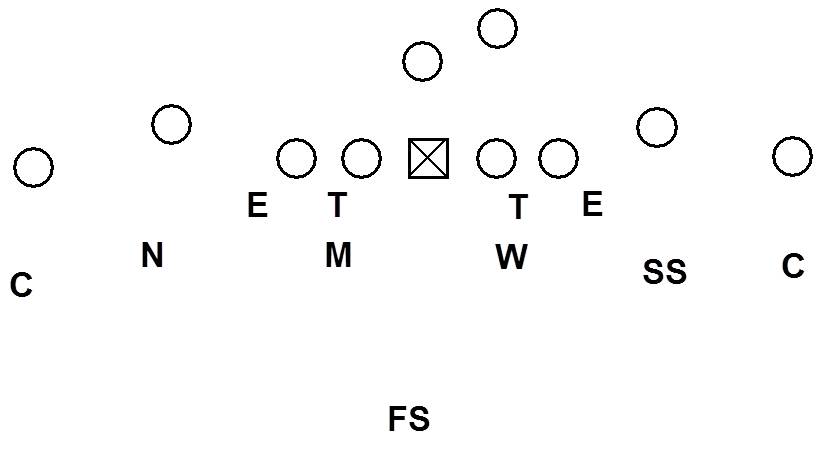
Here is an example from an old playbook of HOF Coach Dick Lebeau


Another example from former NY Giant Defensive Coordinator Bill Sheridan.


Most defensive playbooks have a situational football section with coaching for 2 Minute, 4 Minute, Final plays, etc.

The Bears did a tremendous job against the Buccaneers executing in 4 Minute defense. 

1st 10 from the -16 yard line 2:48 remaining. 


The Bears are in a reduction front vs. the Bucs 13 personnel. The front is spaced like a 6-1 with the walk down safety in a choke on the inside TE.


The gapped out alignment to the TE side creates a very difficult angle/block for the H. The 5 tech DE is able to create a TFL. Timeout Bears.

2nd 12 from the -14 yard line 2:43 remaining. 


The Bucs came back on 2nd down expecting Chicago to again go to a run heavy loaded box with man coverage. The Bears present a look similar to 1st down. Tampa calls a play action to attempt to attack the aggressive run stopping nature of the Bears' 4 Minute defensive call. 


The Bears use a 4 man rush Cover 3 on 2nd down instead. Chicago drops a LOS LB into the X's slant window and has zone coverage to handle the TE's and RB check down to the strong side. Incomplete pass stops the clock setting up 3rd & Long. 

3nd 12 from the -14 yard line 2:37 remaining. 


On 3rd down the Bears match the Bucs' 11 personnel with Dime personnel. The coverage allows Dime coverage on the RB as well as Safety help for the Corner on the X receiver weak. The TE stays in to help control a dominant pass rushing DE. Strong side the Nickel has help from the ILB underneath as well as Safety help over top in the slot. Incomplete pass and the clock stops.

Following the punt.


The Bears take over 2 yards shy of midfield with 2:21 on the clock and 2 timeouts remain. The Bears drove to kick a field goal to win 20-19.

Great execution from the Bears and Defensive Coordinator Chuck Pagano in 4 Minute Defense. This is a great example of why situational football is so critical. Defensively 4 Minute is area that must be coached and practiced in the same way 2 minute and other situations are handled in preparation.

Wednesday, July 15, 2020

Defending Sail Route in Cover 3

The 2017 Titans are in 3-4 personnel playing a 4 man rush Cover 3.


The Browns are in a 12 personnel bunch running a naked off zone blocking with a 3 level sail route to the the strong side.


The sail route is designed to put the strong C-F player in a high low bind. The Corner is gone with the 7 route. The C-F defender is shown a hard run action. This helps control the depth of his drop. Next the C-F defender is being quickly out leveraged to the flat. If the C-F defender stays low on flat route the crossing route will be open behind him and under the deep 1/3 Corner. Sail route is a stress route on cover 3 for this reason.

The Titans use some nice techniques to mitigate the stress area in Cover 3.


The strong side C-F defender uses a sail technique. Initially he runs to the flat route. As he regains leverage on the route he opens his hips inside and gains depth. This gives him the vision to the see the QB and work into the throw window to the crosser. The post safety uses a nail down technique. The Safety comes out of the post and takes over the crossing route. The Corner replaces the Safety in the post. The nail down not only helps cover the crosser it also helps flatten his route. If the crosser attempted to climb to gain more depth over the C-F defender the nail down Safety can undercut the route. The crossing route's depth helps the sail technique C-F defender make the play.


Great stuff from the master Dick Lebeau in is final NFL season. 

Friday, November 18, 2016

Don Brown Pass Rush Twist

Here is a 4 man pass rush twist Michigan Defensive Coordinator Don Brown utilized last season when he was coaching Boston College. 


The DE's are slanting inside. The DT's are looping to contain opposite of their initial alignment. 


A more traditional double twist from a DL looks like:


Both have the DE's going inside and the DT's looping. Crossing the DT's creates an interesting challenge for the pass protection.

The initial inside looping action of the DT, looks and feels like a DT twist.


The loop causes the guards to squeeze inside and put their vision to the opposite DT. With the Guard's attention inside the End has a 1 on 1 inside rush opportunity vs. the OT. 


For the offense to pick this stunt up the OG and OT have to set inside and redirect back out.


It is a difficult task for the guard to transition his eyes from DT to opposite DT and finally to the End. If he does get his eyes in the right place, he then has to physically handle redirecting and blocking the End. 

The OT has a difficult block due to lack of initial help from the guard. On a traditional DE/DT twist the OT will squeeze hip to hip with the OG. The body position of the OG helps stop the momentum of the penetrating DE. Once the DE is controlled the OT can set back outside to the looping DE. With the DT looping from the other side, the OT gets less help initially. No body positioning help for the OG means the DE may simply win the inside 1 on 1 pass rush. The other challenge is the OT may be engaged, locked on, and deep in the pass set by the time the looping DT from the opposite side shows up. In that case it is difficult for the OT to redirect and pick up the looper.

This same twist can be found other places like a old playbook from Tennessee Titans Defensive coordinator Dick LeBeau.


Tuesday, November 15, 2016

Tennessee Titans Man Free Blitz

Here is an interesting concept from legendary Titans' Defensive Coordinator Dick LeBeau. The Titan's are a base 3-4 structure. However, they very rarely look like the 3-4 diagrammed below.


The Titan's use their base personnel against run heavy personnel groupings.


Often against these formations the 3-4 reduces the front, playing the OLB's at the LOS to create the under front and other base defensive structures.

Against spread formations with 10 or 11 personnel the Titans will sub to a Nickel or Dime package. 


While it may look like the normal 4-2-5 defense there are some differences. In the NFL most of the 3-4 teams sub out the Nose for the 5th DB. The DT's in this diagram are the ends in the base personnel grouping while the Ends in this package are stand up OLB's. Subbing into a 4 man line nickel package does have a some limitations. One being the defense can't bring 3 down odd front pressures from an even front.

The Titans have a solution.

Tennessee is using the sub nickel package but bumping the front to create an odd front look. This concept allows the defense to bring pressures like:


The Rush:
Mike & Will - Contain
End & Tackle - Long Stick to A Gap
End - B gap blitz
Tackle - Jap then loop to B gap

This is an America's Blitz variation. The twist action of the long stick DT with the looping zero technique creates an America's blitz effect on both sides of the formation.

The Coverage:
Man Free with the rushers covering the RB if the RB attempts to block them.


The offense has the numbers (6 vs. 6) to block the rush.


The left side (blue) picks up the pressure exactly as expected. The right (red) side is where the breakdown occurs. The guard is expecting the Center to be occupied with the zero technique. The guard sets out the B gap rush threat (either the Tackle or Will). When the Tackle long sticks the OG doesn't know initially if he will get help from the Center.


The Center squeezes the protection to the long stick DT when the zero technique loops. The guard locks on the long stick and realizes too late he needs to redirect to the looping zero technique. By the time the guard reacts the looping zero technique is through the B gap and pressuring the QB. 

The Titans found a create way to bring odd front pass rush from an even front personnel. The usage of the Zero and 5 tech on a twist that plays out like America's blitz is also creative. This concept is a good way to get the zero technique a better pass rush option. Often an odd front nose is forced to fight through a center from a head up alignment. The Center often has protection help from one or both of the guards. In that environment, pass rush opportunities can be tough to come by for a zero technique. Creating rush opportunities for the zero technique to use athleticism is a good change of pace from simply asking him to bull rush the mid-line and push the pocket. 

Tuesday, May 19, 2015

FAQ - What is America's Blitz?

I thought I would attempt to answer a question I am asked frequently in e-mail. What is America's blitz? 

America's Blitz is a colloquial term for the following blitz concept:


The blitz is known as America's Blitz because "every" team in America runs it. I have also heard the blitz called the NCAA Blitz. The name similarly implies that every college team runs this blitz. While not every team is running the blitz it is very common. Looking in a few NFL and college playbooks here are a few examples of the America's Blitz concept.

This example is from long time Pittsburgh Steeler defensive coordinator Dick Lebeau.


Here it is from Mark Dantonio's time as Ohio State's defensive coordinator. This variation of the concept is being run from a 3 man line sub personnel with multiple DB's in the game.


Here from Nick Saban's defense at Alabama in Base personnel.


Another example of America's blitz from Coach Saban being run out of sub personnel Nickel or Dime.

Here from Bo Pelini's Nebraska Defense

From Rex Ryan's NY Jets Defense


It doesn't take long to see why this concept is known as America's Blitz. 

Why is this blitz concept so ubiquitous? Simple answer it is effective. The deeper answer is versatility.  This blitz concept can be run from nearly all base and sub defensive personnel groups. Defenses also have the flexibility to play man or zone coverage behind this blitz. 

The blitz also has usage versatility. The blitz successfully attacks both run blocking schemes and pass protections. Defenses who carry this concept into a game plan can have confidence this blitz can be effectively called in multiple situations.

The success of the concept comes from the blitzes ability to overload half of the offense, attack the blocking scheme, and adjust based on the offense's blocking.


The concept is simple. The outside blitzer (Sam) is off the edge as a contain player. The DE to the blitz is slanting to the A gap. The inside blitzer (Mike) is letting the DE clear first and blitzing the B gap.

Several situations can play out based on the offensive blocking scheme.

The first situation is the offense zone blocks to the blitz. The zone could be either a zone run scheme or zone pass protection.


If the offense is disciplined in their zone blocking the offense has a blocker for each defender in each gap. In this situation the Sam, Mike, End, and Nose all have excellent gap leverage and the ability to shed blocks and make a play. This blitz challenges the offense to stay disciplined in their zone blocking.

The DE slanting to the A gap creates a conflict for the Guard. The Guard initially feels like the DE is attacking the B gap. In that case the Guard is responsible to block him. As the guard realizes the DE is actually slanting down to the A gap, it may be too late for the Guard to transition and make a good block on the blitzing Mike in the B gap.


The Center has a similar conflict. If the Center engages with the Nose at all, the Center's block on the DE slant to the A gap is very difficult.


Another situation is the OT blocks down on the DE slanting to the A gap. 


As the offense's blocking collapses down the defense has a 2 off the edge blitz concept. This situation can play out vs. both the run and the pass.

Versus the block down and kick out schemes like power the defense is able to get two blitzers to the point of attack.


As the OT blocks down the Mike is blitzing the B gap area. With 2 blitzers off the edge; the Mike is able to spill and the Sam is able to contain. 

Versus the pass the offense is likely running a slide scheme away from the blitz. If that is the situation the blitz creates a 2 (Mike & Sam) on 1 (RB).


Here is some video of the Dick Lebeau coached Pittsburgh Steelers running the concept. This video is courtesy of an excellent article about Coach Lebeau's Strong Scrape Fire Zone from Coach Hoover.


Tuesday, April 21, 2015

Firezone Coverage vs. Action Passes

This post is continuing the coaching points for 3 under 3 deep Firezone coverage. These coaching points come from the 2003 Kentucky playbook of defensive coordinator Mike Archer


Firezone vs. Boot


  • Corner to the action - Cover all of #1 out or vertical
  • Seam player to action - First to the flat
  • 3RH - Find and cover the crosser
  • Seam player away from the action - Throwback. Alert or the running back or crossers coming back 
  • Corner away from the action - Cover all of #1 vertical
  • Post Safety - Alert for the deepest crossing route

Zombie 

Call alerting Safety and Backside Corner #1 strong is in a crack alignment. 
Vs. flow pass, FS will rob dig if TE crosses and backside corner will drive to the post

Flow Pass = Play Action pass with both backs to the TE and the TE running a crossing route


Against a play action flow pass with a crack alignment of of #1 the defense will make a Zombie call pre-snap.


When the #1 receiver strong goes in crack motion the Corners and Post Safety must communicate with a "Zombie" call.

The Zombie call allows the the Post Safety to rob the dig. If the 3RH player is fooled by the play action fake the defense is still able to cover the levels route from the offense. The Zombie call tells the backside corner to overlap to the middle of the field and double cover the post with the other corner when #1 on his side runs a dig.

The defense would make the same Zombie call vs. a #1 aligned in a reduced split crack alignment.


Here the offense aligns with #1 in a reduced split. The defense makes a Zombie call to alert the Corners and Safety of the reduction of splits. The post safety robs the dig when the TE runs the crossing route. The Corner overlaps when his #1 runs the dig and double covers the post.

Zombie can be a good solution in a 3 deep coverage concept to handle play action and cover the levels route combination. 

Friday, April 17, 2015

Firezone Coverage Seam Technique Coaching Points

Long time Pittsburgh Steeler Defensive Coordinator Dick Lebeau (currently with the Tennessee Titans) is known for his firezone pressure package. Coach Lebeau’s 3 under 3 deep firezone coverage concept has been the topic of multiple posts on Blitzology in the past. This post is a continuation of those same concepts. The following information is from the 2003 Kentucky Defensive Playbook. The defensive coordinator was Mike Archer. Before his time at Kentucky, Coach Archer served as the linebacker coach for the Pittsburgh Steelers from 1996-2002. With Coach Archer coming from the Lebeau coaching tree much of the firezone terminology and techniques are similar.

This post focuses on the Seam Drop. Coaching points for this drop from Coach Lebeau were covered previously on Blitzology (Here).


The Seam technique from Coach Archer follows many of the same coaching points.


The basic structure of the 3 under 3 deep coverage is:

3 Under
Seam
3 Receiver Hook
Seam

3 Deep
FZ 1/3 Corner
Lean Post Safety
FZ 1/3 Corner

The diagram shows in the simplest form the responsibilities of the Seam player. If the #2 receiver runs:

Outside = Match
Vertical = Carry
Inside = Deliver

Coach Archer defines the Seam drop in the playbook. 

Seam Drop – Played in 3 underneath 3 Deep zones. Align inside or outside of the #2 receiver. Match-Carry-Deliver the deepest and outside of #2 or #3. Vs. a removed #2 with over split between he and #3 align inside and drop inside the #2 receiver and work to his outside shoulder – maintain vision and break. 


The seam player aligns 1-2 yards inside of #2 and 6 yards deep vs. a wide split between #2 and #3.

Coach Archer goes on to define Match-Carry-Deliver

  • Match #2 / #3 outside leverage on any flat release. 
  • Carry #2 / #3 outside in vs. any vertical route. 
  • Deliver #2 / #3 outside in on any inside release until forced to come off with either a call or another eligible crosses your face from the inside out


Here are some example diagrams.


Carry - Cover the deepest / outside of #2 /#3

The Seam player is working from inside to the outside shoulder of the vertical release of #2. The Seam player will only collision the #2 outside in and never inside out. All of the Seam player's help is inside from the 3RH and the Lean Post Safety.


Leverage with width and vision

The Seam player drops with width and then squeezing inside.


Match = Leverage first to the flat of #2 / #3

The Seam player is playing with depth over the first to the flat (#3). This should keep the Seam player in the window of any route by #1.


Against two releases in the same direction play deep to shallow.

By keeping depth over the first to the flat the Seam player is still in body position to play deep to shallow on the #2 and #3.


 Deliver #2 inside until another color crosses your face outside.


Match & Carry
Match the first to the flat of #2 / #3
Carry any flat and up


Vs. Flood = Lock #2


Flood = 3 Receivers releasing into routes to the weak side of the formation

Lock – Puts a defensive player “locked” on a receiver regardless of receiver’s release 

If the #3 receiver is releasing away from the Seam player the Seam player locks on the  #2 receiver and covers him man to man.


Against any D area motion the Seam player locks the #2