Found this teach tape I made back during the Covid break. Decided to share, so it is now available for free on CoachTube. Hopefully there is something in there you find helpful.

Thursday, June 20, 2024


Friday, December 16, 2022
Wristbands to make Play Calls
Here is a simple wristband organization and template. The goal is to make the wristband easy for the players to locate and read the calls while also being flexible enough to alter the play calling pattern. The flexibility of signaling in the call helps prevent issues if calls are repeated throughout the game, if the signalers are visible on game film that is exchanged to future opponents, or if a regular season opponent is played again in post-season play.

The setup is 9 sections with 5 calls per section allowing for 45 calls on the wristband. At the top of each section is a: City, Body Part, Color, and Number. If the play caller signals Atlanta 2 the players read the call located in the Atlanta 2 location. They will find "Over 4". If the call is Tampa 5 the players find "G Aim 3". Where the multiplicity comes into play is the 4 categories at the top of each section. Chicago 1 for example is "G Inside Magic". If the call is signaled Chest 1 instead the call is again "G Inside Magic". Gray 1 also = "G Inside Magic". Additionally the number in that section is 30. So if the call comes in 31 the call is again "G Inside Magic". There are 4 ways to signal in the same call. City #, Color #, Body Part #, or double digit ##. 53 is "Under 6" the next play could be signaled in as Hip 3 and the call is again "Under 6".
This allows the play caller to change up call to call within a series. Or more likely to tell players this series, quarter, half, or in this week's game we are live on Colors. However in the next series, quarter, half or game the calls may be live on Body Parts instead.
One hard and fast rule we used is the categories of calls don't move. 20/Boston/Belly/Black is always located in the top row and center column. This is like a watch.
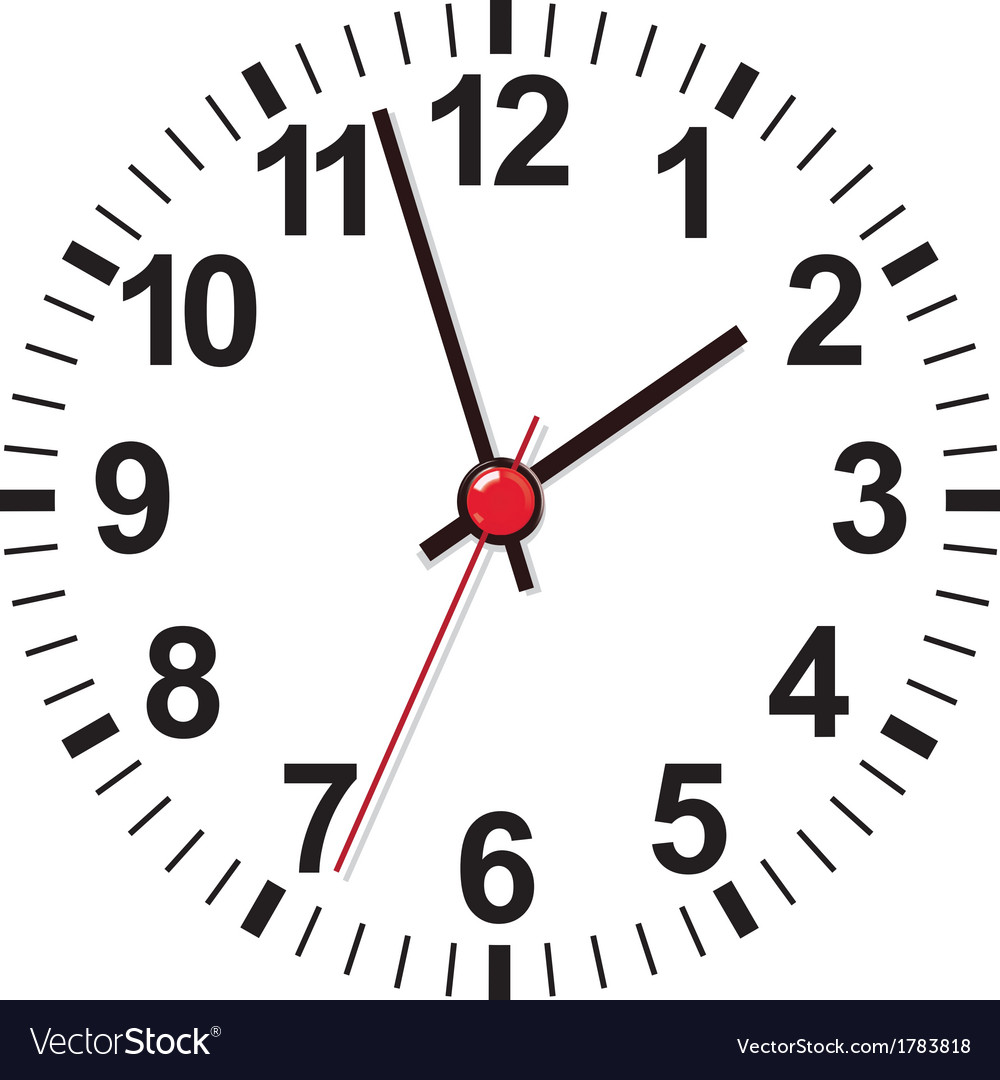
When you look at a watch 12 o'clock is located top center, it doesn't vary. The location doesn't move so it is always easy for someone telling the time to locate 12, 3, 6 etc. The same is true for the player reading the wristband.
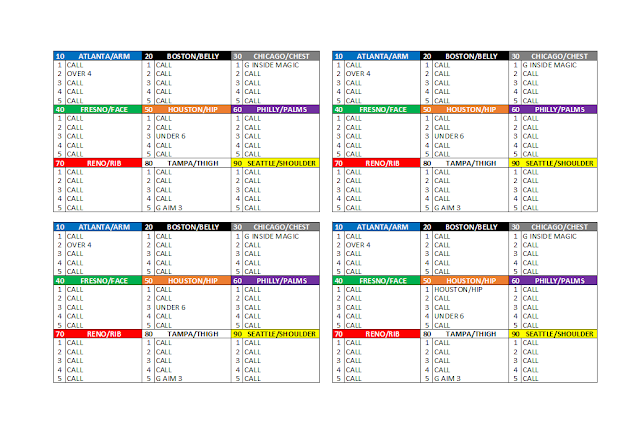
The template is set up with 4 wristband inserts on the page. The top left is where the calls are typed in to the wristband. The other 3 autofill with whatever is input in the top left calls. This insures the wristbands will match and avoid the dreaded non-matching wristbands situation.
If you want to download the template you can here.
Thursday, July 1, 2021
Fangio Read the Turn Pressure
Here is a simple Cover 1 dog from Vic Fangio's 2017-2018 Bears defenses with a rushing LB reading the turn of the protection. Bears are in Nickel personnel.

The Rush:
DE's are wide rushers. Front has a DT in a 3 technique to the side of the RB with a shade DT away. The LB opposite the RB is reading the OG's pass set. If the guard sets inside to the shade DT the LB pressures the B gap. If the guard sets out to the LB in the B gap the LB loops to the opposite A gap to find daylight in the rush.
The Coverage:
Cover 1 man free coverage with the LB to the RB in man coverage on the back.
First example is on 2nd&7

The guard sets out to the pressure LB, the LB wraps to the opposite A gap. The pass set for the Center is very difficult. The LB is able to win vs. the Center on the redirection set. The pressure also creates a 5 vs. 5 pass rush. The DE is able to win his 1 on 1 vs. the OT on the edge.
2nd example is a 1st&20 later in the game with the Bills in obvious pass mode.

3rd example is on 3rd&8

4th example on 3&8

5th example on 4&6

The pressure LB gets the Guard setting wide on the movement pass with the QB getting out of the pocket. The LB doesn't wrap inside and instead works for width to continue pressuring the QB as the launch point changes. Added bonus in coverage is the hover technique of the DB on the TE. When the TE blocks to help secure the edge for the QB sprint out, the DB hovers. Hover is staying over the top of the man responsibility with depth and vision on the man and the QB. This allows the hovering DB to break like a zone dropper would undercutting routes around him and providing help to man coverage defenders. The QB attempts to throw the ball on a lower trajectory with velocity to fit the ball in vs. man coverage. The man coverage throw allows the hover DB to vision and break getting his hands on the ball.
Good stuff as always from Vic Fangio. He has been coaching good defense for a long time. I'm excited to see his defense in Denver this season.
Thursday, June 17, 2021
Time Machine Article
Was looking on an old flash drive and found a scanned article from back in 1998. This article was one I read in high school that helped spark my interest in pressures and the concept of zone blitzing. Come for the throwback football article stay for the cowboy collar pictures and Jumpsoles ad.


Saturday, April 24, 2021
Limiting a Great Receiving threat in 12/21 Personnel
12/21 personnel groupings present a number of stresses to a defense. The obvious threat is run heavy structures using big personnel with a TE/FB creating extra gaps in the run fit. Heavier personnels often induce loaded boxes and 8 man front structures from a defense to handle the run game. Those loaded box defenses can also create single coverage for a star WR. This can lead to offenses using those heavy personnels/sets to attempt to isolate their best WR creating passing opportunities off max pro, play action, quick game, or RPO concepts. These personnel groupings also allow for a variety of 6,7,8 man pass protections. What is the solution in regular down & distance situations? How do we stop the run while controlling the star receiving threat? Here is a solution from the 3-4 spaced defense using quarters and halves coverage principles. Putting a cloud on the star WR can be a really inexpensive solution to mitigate some risk.
The coverage concept combines two coverages: Stuff and Roll. Stuff is a 1/4 1/4 1/2 concept while Roll is a double rotated Cover 2 concept.
The point is an activated OLB as the 4th rusher. The Mike will make a Rome/London call to activate an OLB. We are going to activate the OLB to the side of the star WR.
Vs. 21

Against a pro set if the star WR is to the defensive right the ILB will make a Rome call to set the point. The point OLB becomes part of the charge. The coverage will play Stuff coverage against a formation with the star WR as a single X. Stuff means half tool to the point and a quarter tool away from the point. Structurally this allows the defense to be sound numerically in the box vs. the run while putting a cover 2 concept on the star WR to disrupt passing concepts. Here the quarter Safety must trigger to become the 8th fitter in the box when the TE blocks.

When the star WR is strong the LB again will set the point to the star. Here London is the call with the star aligned to the defensive left. London activates the left OLB into the charge. The coverage will be Roll. The coverage shows as cover 3 rotated to the point with a Safety down and a Safety in the post. Showing a middle of the field closed look helps dissuade the offense from attacking the middle of field based on pre-snap coverage presentation. At the snap the post aligned safety rolls the coverage to a cover 2 concept strong with an inverted cover 2 concept weak. When the TE blocks the vertical hook down Safety become the 8th fitter for the run. Again this concept gives the defense an 8 man front spacing vs. the run with a cloud on the best WR.


Vs. 12


Against a 2x2 ace formation the point will gain be to the star. The coverage is stuff with a half tool to the point and quarter tool away. The quarter safety helps build the 8 man box while the cloud helps deny the star.


Against a 3x1 nub set the coverage is again Roll. The coverage rolls against any single width formation. The coverage denies the star outside or in the slot similarly to the previous twins example. The ILB does have the TE vertical to the strong side in a match so that's a matchup we are always mindful of in this concept.


With the star as the single X the coverage is Stuff. Half tool to the point with a quarter tool away. Here there are 3 receiving threats to the quarters side. That means the tool needed must be a quarter tool for 3 receivers. In this example the quarter tool is a mini 2 concept with the outside WR manned by the Corner. Inside the OLB/ILB/Safety are playing a 3 over 2 coverage on the 2 TEs. The Safety in the mini concept strong must trigger when the TE's block to add the 8th fitter in the run game.

Putting a cloud on a good WR in heavy personnel can be an inexpensive way to both be good vs. the run and deny the biggest receiving threat. Much of the coverage concept is built from coverage tools that most defenses already have in the their toolbox.
Thursday, March 4, 2021
Coaching the Rat in Cover 1
Here is a few coaching points we use for the rat in the hole when preparing the rat to cut crossers in Cover 1.
- The hole player does not need to drop quickly. By sitting low the hole player is in a good position to collect a low crosser. If there is no crosser the hole player will drop into the hole. The hole player will be under all intermediate crossers. There is NO rush to get to the hole drop.
- Keeping a head on a swivel is important to see the crosser. You cannot stare down the QB and see a crosser.
- Communication is key. If there is no “cut” call there is no cut. The hole player must tell the man defender he is taking over the route. Man defenders stay in man until the cut and collect by the hole dropper.
- Alerting man defenders where you are looking first is helpful for them to anticipate you will be cutting their man. An alert does not guarantee there will be a cut. The alert only tells the coverage players where the hole player will look to cut first. The call alerts the man coverage players and talks to his partner(s) in the funnel telling them where to look first.
Where to Alert?
We start with a camp rule.
Against 2x2 formation, look boundary first. Why? The low
crosser running from boundary to the field is the bigger threat to catch and run
going to all the open space. Also the boundary low crosser will get to the hole
player faster than the low crosser from the field due to reduced split into the
boundary.
Against 2x2 formation in the MOF, look to the side of the RB
release 1st. Why? Many teams release the RB to the side of the low
crosser.
Against 3x1 formation. Look strong first.
Against Empty look weak first.
Be aware of any reduced split by a receiver. Look to the
side of the reduced split first regardless of 2x2 or 3x1 or Empty.
Be aware motion can change the situation.
Game Planning the Cut
We will set the alert rules by game plan based on scouting
report. Those rules may adjust by down & distance, formation, defensive call, etc.
No Cut – One consideration is to have a no cut rule. The
hole player will drop to the hole and will not cut any low crossers. We use
this on longer down and distances. On 3rd & 12 we may be looking
to deny the intermediate crosser and force the ball low to break and
tackle the route short of the sticks. We can also set a “no cut” rule on a specific
receiver. In that case the hole player will not cut because we want to maintain
our pre-snap man match-up and avoid asking the hole player to take over that
receiver in coverage.
TE Only – Against some teams having the hole player cutting
a WR may not be a realistic matchup. In a TE only rule the hole player will
look to cut a Y on a crosser. If there is no crosser from the Y then drop to
the hole. The hole is not free to cut any WR on a crosser.
TE first – Tendency may dictate the alert goes to the TE
side. The hole player will look to cut a low crosser from the TE side first.
Then scan opposite.
Slot First – Tendency may dictate the alert goes to WR
aligned in the slot. The hole player will look to cut a low crosser from the
slot first. Then scan opposite.
Reduced Splits – Tendency may dictate the alert goes to WR
with a reduced split. The hole player will look to cut a low crosser from the
side of the reduced split first. Then scan opposite. This can include being
aware of bunch and stacked WR formations.
To a WR - Tendency may dictate the alert goes to a specific
WR. The hole player will look to cut a low crosser from the side of the
declared WR. Then scan opposite.
Flip Alignments - Which WR is on/off the ball may indicate where we want to alert by tipping where we should expect the low crosser.
Strong/Weak/Field/Bench - Tendency may dictate the alert
goes to the strong side or weak side of the formation or to the field or
boundary.
By RB location - The RB alignment in may tip route combos and dictate where we want to alert. The RB location in gun, his depth, a cheated wide alignment, RB and TE paired/split etc. may be indicators for the alert.
By formation – Specific formations may carry cut rules to
alert to a specific place. Those cut rules may be specific to that formation
only.
Short motion – Tendency may dictate a short motion rule.
Teams may want a reduced split and use late short motion to get the WR on the
run to a reduced split alignment. The man coverage player will alert the hole
of the short motion. This is the only alert that comes from a man player and
not hole player.
Alert side only - The hole player will cut to the side of the alert but will not scan and look to cut opposite, if there is no crosser from the alert side the hole player will work for depth to the hole. This allows the man coverage player opposite the side of the alert to play inside leverage man. This can make sense in some game plan situations.
Thursday, February 11, 2021
Adjusting the Run Fit in Fire Zone Pressure
Fire zone has run fits like all other defensive calls. Those fits can be adjusted to help prevent issues or account for stress areas.
Here is an example with a number of errors resulting is a good gain for our opponent.


We called this pressure to have the DL slanting to the boundary with the walked up OLB on a low track spill course and the ILB going from depth on a wide track. This is a variation of America's Fire Zone. When the OT blocked out on the OLB the Sam should have gone under the block. The expectation is the Sam will go inside/under blocks because the ILB will be pressuring on the wide track outside. That is one of many mistakes on the play, the Sam stay outside. We also have an "I'm IN" or "I'm OUT" call happening here from the Safety. In this example there is a split #2 resulting in the down Safety saying "I'm OUT" meaning the ILB has the wide track.
If the #2 was in a cut split or a TE the Safety would have a better angle for the wide track and would call "I'm IN" taking the wide track pressure pattern and job swapping his seam drop to the ILB.

This is a run pressure concept, the angles can be beneficial to alter who is in the pressure pattern based on the formation.
Why take on this type of complexity? Why not just let the Mike be the wide track the whole time? Don't make it harder than it needs to be.
On this call the #2 went in motion.

The Safety ends up on the edge of the box playing like we don't have any "I'm IN"/"I'm OUT" rules on.

Let's assume we did coach it with no "I'm IN"/"I'm OUT" rules in place. The Mike would pressure no matter what. The Safety needs to vise the lead block with the Will LB. The ask of the Safety here is very very big. The Safety cannot be too aggressive running into the box when he reacts to motion to avoid several problems:
1. Running into the off the LOS ILB wide track pressure from the Mike
2. Over running any potential run by the RB to the pressure side
3. Over running any potential route release from the RB or Y off
4. Over running any return motion from the #2
Just like in the actual clip the Safety ends up being too far from his work to fit the vise on the lead block and the run fit has issues.
If we had correctly handled the "I'm IN" call on this play.

Something like "I'm IN"/"I'm OUT" may seem like unnecessary complexity at first look. That added complexity got us on this play as we didn't coach it or execute it well enough. You can choose to use that as strikes 1, 2, and 3 for why you don't need something that might create confusion. However, when executed correctly it relieves a great deal of stress on the players.
What is another option if I don't like the "I'm IN"/"I'm OUT" concept but I'm worried about the stress on the Safety.
Another option is to set pressure Strong (To the Pass Strength) instead of to the wide field.

In the original example the pressure pattern adjusted with "I'm IN"/"I'm OUT" but stayed coming from the field. In this concept the pattern is declared to the defensive right because that is the pass strength. This version has no "I'm IN"/"I'm OUT" rules and will always be an OLB + ILB pressure pattern.
When motions happens the pressure is changed to the left.

The pass strength is now the left. The defense must now reset the pattern with a left declaration. The new pressure is well positioned vs. runs to the TE side. However, this does create stresses too. The LB's/Safeties have to communicate and adjust quickly to the motion. The DL must hear, understand, and execute the new left call in the pressure pattern. The rotation of the Safeties also creates stress to execute. Lastly, the adjustment also places some stress on the plays like split zone and counter going away from the motion.
These two options are both tools to have and rep to help take some stress off the players when motions happen in the fire zone run fits. The set it and forget method works in some contexts but if the offense begins to stress those hard called pressures that don't adjust there are only really three options:
1. Make no adjustment and ask the players to repeatedly execute difficult tasks, this includes the player over playing to achieve the difficult task and creating other potentially bigger issues
2. Allow the offense to chase you out of fire zone pressure calls
3. Have tools available and understood by the defense to be able to adjust.
It is easy to throw a cutup of good pressures on and say "see it works". Well what about when it goes wrong? What are mechanisms of failure? This post hopefully shows a failure we had in way that not only addresses how and why but also gets to the why behind adjustments we carry and coach. Having the tools available is the key to being a complete defense. It takes constant work and there will be failures. Those failures can fortify why we are doing what we are doing, to give players the best possible chance to succeed. Simplicity for simplicity's sake and unnecessary complexity both undermine the goal. A clip like this one isn't fun because we failed on the play however it is invaluable for helping players and coaches understand the why. Good luck as you build your tool box and master your tools.
Monday, February 1, 2021
Football 101 - Spill vs. Box
This is a short explanation video of the defensive concepts of spill and box. Many people are interested in learning about football, the biggest barrier to entry is football vocabulary. There is no universal football terminology so this video uses generic terms to establish general definitions of the concepts.
Friday, January 22, 2021
NFL Film Study Part 3
This week the cutup is the Colts in 2 under 3 deep hot coverage bringing 6. Watch, save, or share. Cutup will be available this week only.

Friday, January 15, 2021
NFL Study Part 2
Been studying NFL scheme and making cutups. Watch, save, share how you like. This cutup will be available for this week.

Friday, January 8, 2021
NFL Off-Season Study
Been doing studies of NFL scheme. Going to start releasing cutups on Fridays. Watch it, save it, share it however you like. This cutup will be available this week and a new one will be up next week.

First cutup is teams using box technique vs. counter gap scheme runs.
Wednesday, December 16, 2020
Giving the Corner Relief in Isolation on the X in 3x1
When the Corner is isolated on the X on the backside of 3x1 formations it can be nice to find calls that help provide that Corner some form of help. In our defense we call these concepts relief calls.
Here is an interesting example of a relief concept from the Ravens. Baltimore is in a Nickel personnel with 2 OLB, 3 DL, 1 ILB, and 5 DB's.

The Rush:
The Nickel is edge pressuring off the slot while the rush OLB and DT work a twist game. Weak the DE is a B gap pop.
The Coverage:
3 under 3 deep firezone with the Nose spying the RB

Weak side the presence of a Rush OLB on the LOS, 4i DE, and shade Nose forces the C, G, T to set to the 3 threats. With the turn of the Center weak, the protection has 3 threats (Nickel, OLB, DT) vs. 2 OL and the scan RB strong. The twist creates confusion with the G squeezing to the most inside threat from the wrapping OLB. The OT fans to the Nickel instead of squeezing to the DT. The RB scans to the Nickel who is blocked by the OT leaving the DT on a free run. The protection has the numbers to account for the pressure but sorting it out is difficult. If sorted out the concept forces the RB to block across the formation on a full speed Nickel off the edge and the T/G to handle the twist 2 vs. 2.
The OLB walked on the LOS weak is able to key the QB's front shoulder intentions and buzz out to provide an underneath zone dropping body presence to the Corner. This prevents the Corner from having to be completely isolated in coverage and results in the interception.
The usage of the Nose as a spy on the RB is what makes this coverage execution work.
If the Ravens had truly rushed 5 and played firezone the weak seam dropping OLB is relating to the weak #2 (RB).


If the Rush were to key the QB's front shoulder intentions to the X and buzz out he could again help on quick game. However, if the QB resets his feet and throws the RB a screen or check down there is a hole in the middle of the coverage. The Seam and 3RH droppers strong are expanded to cover #2 and #3 strong. This is a specific risk as the Browns have two good RB's, screen is a threat from backed up field postion,and the Browns hit earlier in the game on both a TE screen and a RB screen.

Notice the QB's front should intentions are initially away from the RB screen.
The decision to utilize the Nose as a spy helps solve this problem. The Seam dropping OLB can react to the front shoulder intentions of the QB and help undercut routes to the X. The Nose helps mitigate the risk on the RB screen and check down.

This example is a completely different pressure pattern but illustrates another application of the concept. This example is from the Rex Ryan/Mike Pettine Jets. The current Baltimore scheme has crossover with the schemes of Rex/Rob Ryan.
The usage of the Nose as a spy shows up in many defensive schemes.


This example is a completely different pressure pattern but illustrates another application of the concept. This example is from the Rex Ryan/Mike Pettine Jets. The current Baltimore scheme has crossover with the schemes of Rex/Rob Ryan.
The usage of the Nose as a spy not only helps the OLB provide relief to the Corner in coverage. It also:
1. Gives the Nose a coverage responsibility the Nose can execute and has a reasonable installation cost. Teaching a Nose a hook zone drop would be much more expensive to teach for example.
2. Helps manipulate the pass protection. The Center is occupied throughout the pressure mirroring the movements of the Nose. If the Nose drops off the LOS into coverage, the Center can potentially reset and provide help elsewhere in the protection specifically helping with the wrapping OLB from the pressure side. With the Center occupied with the spy Nose, the Center is a non-factor.
Really nice pressure design and usage of Nose spy from Baltimore Defensive Coordinator Wink Martindale.
Saturday, December 12, 2020
Understanding the Opening Script
Many offensive coaches use an opening script to begin a game. What goes into that script? I had some ideas based on my experiences vs. opposing offenses, from film study of a variety of schemes, and from picking the brains of offensive coaches I've had the good fortune of working with in the past. I also reached out to a few offensive coaches to ask them for insight. Finally I crowdsourced info by asking coaches through twitter. The responses and willingness to share was amazing and a testament to the awesome "Football Twitter" community. The sheer number of responses was a bit overwhelming. To all those who contributed, Thank You!
After looking at the philosophy of offensive coaches as well as what they are scripting I broke the responses down into 5 categories: Identity, Diagnostic, Designer, Catalyst, and Cumulative Effect.
Identity - Plays that get scripted that are all about who the offense is at its core.
Top Plays - Call what the OC feels are the best run schemes and best pass concepts in the offense's arsenal. These calls are all about being who the offense feels they are as an offense and don't overly depend on the opponent's scheme.
Sure Things – Runs the OC feels can block any D look. This isn't necessarily the scheme the offense feels is their top production play or most explosive scheme. This extends to passes with protection that accounts the most possible looks. This might include max protection, play action, movement passes like boot/naked/sprint. Plays in this category are all about consistency and reliability.
Get ball into the hands of the best player. What play calls guarantee the top player on offense is involved early?
Get multiple guys touches. A recurring theme was OC's wanting to get as many guys involved and engaged in the opening script as possible. This wasn't always just about getting the ball to the best player but getting everyone in on the action.
Get the QB in a rhythm. What plays allow for the QB to make easy throws? What plays have the easiest reads? This includes not only passes but also option schemes. How can the offense script to create consistent success for the QB early?
Diagnostic - Plays that are scripted to diagnose some piece of info about the defense.
Alignment to formations – Does the defense align in the front and show coverage that match what was is to be expected from scouting report breakdown data?
Motion/trade/shift
adjustments – How are they adjusting? Is there confusion or misalignments? Can offense move one player and get multiple defenders to move? Are adjustments being made by running defenders with motion, spinning/rolling coverage, bumping LB's, sliding DL? This can inform follow up play calls.
Personnel
– Is the defense using the personnel expected from scouting report info. Are players aligning where they were expected? Are matchups as expected?
How does the defense respond to something outside of normal? A new formation, formation into the sideline (FSL), unbalanced, empty, compressed formation, etc are all possible in a script to diagnose what the defense will do. This info can inform subsequent play calls or can be one offs.
Correction
– Is there a formation, motion, or play the defense struggled with in previous games? Have they made corrections? Have they fixed what went wrong previously? Football is a copycat sport. This script element is all about forcing defenses to prove they have corrected their previous errors.
Who
made the play? – Typically this is about running a base/foundational play and looking at what occurred. Who made the tackle or made the play difficult? This informs follow up plays that compliment the foundational play. This could be series based play calling like many wing-t and option schemes utilize. This could also be just an if/then type of game plan. If the backside DE is chasing hard, then call the complimenting naked concept.
Designer- Play specifically designed for the defense.
OC are looking to script potential big plays or plays that create stress. This may be a shot pass play. This could be a trick play like a double pass, reverse, flea flicker, etc. This could be a scheme design from game plan meeting looking a the defense's previous plan. There is no perfect play call for the defense. Offenses know what stresses each defensive concept. It could be a personnel, motion, formation, or play concept but the OC is looking to craft those elements into stress plays in the script. Some designer concepts however are fragile. They may not be great outside of the specific/desired defensive look. Many designer looks in the script also carry a can/alert/kill concept. Two plays are called in the huddle. If the defense is in the desired look the designer play is on as planned. If the look is sub-optimal, the QB cans the play to a base call that holds up against more defensive looks. Some OC's prefer to do this with a check the sideline mechanic vs. asking the QB to can the play at the LOS.
Catalyst - Plays designed to provoke a response from the defense.
Catalyst concepts take many forms. Some may be simple like getting in a 3x1 and taking a shot to the X in isolation. The catalyst is all about looking to force the D to respond by playing some type of weak 2 over 1 coverage concept. The O certainly would like to complete the pass but the bigger goal was to create opportunities to the 3 receiver side or in the run game. Catalysts can be schemed in the run game also. The O may feel the best path to success running the ball is to get the DE aligned in a specific location on the TE. Scripted early calls like pin & pull may not be the O's most desired scheme. It is being scripted to encourage the defense to widen the DE's alignment, which sets up the opportunity to run other schemes on future plays. Not all catalyst plays provoke the same type of responses. Some OC's are scripting looks that are meant to confirm to the defense what the offense looks like. These are scripted calls that mirror the expected looks from the scouting report. The personnel, formation, play, etc was what the D expected based on film study. The goal here is to provoke the defense to be locked into their plan. If the D feels confident the O matches the scouting report, they are going to do what they planned to do on defense. Once the offense is locked into what the D's plan looks like it sets up the plan of attack. Most OC's don't like defensive variance so the catalyst may be to get the defense locked in a specific plan. Catalyst plays may take the form of setup plays. A distinct motion or formation leads the defense to talk it over on the sideline. When that look comes up again defenders make the ID and believe they know what is coming off that look. This may be where the setup leads to the payoff. The offense wanted the D to feel like they know what is coming and really cared much more about the payoff play vs. the setup play. Catalyst plays may be about manipulating defensive personnel usage. An offense that uses 11 but begins flexing to create 10 personnel formations vs. more traditional TE in the core 11 looks to get the D into sub-personnel. Once the D is subbing to Nickel or Dime, the O can attack those sub-personnels by putting the TE back into the core and running their base 11p package. The O may go 22 personnel to get the D in base personnel but create an empty formation and isolate a TE vs. a LB. Catalyst plays can take many forms but they want to force the defense into an action favorable to the offense.
Cumulative effect - Plays that aren't about a single play but affecting the defense through repetition.
Perimeter
run/screen – The goal is to force the DL to run sideline to sideline. Tiring out DL early in the game can affect pass rush, run fits, block shed, pursuit and overall effort.
Establish tempo of the offense. Many OC's mentioned wanting to set or change the tempo in the script. This concept is also tied to creating fatigue on the defense early in the game. This may also get the D into more basic schemes.
Attack the best player – If the defense has a great player the offense may look to make that player's life difficult. A defense with a dominate 3tech DT for example. The offense may script early concepts that double him, trap him, wham him, read him, and screen him. That player is now getting hit from all angles. The goal is to create frustration and prevent that player from getting going. A slow start for that player may keep him from getting going at all.
Attack the worst player - Isolation of a weak link on defense with the goal that enough attacks on the weakest player will lead to big plays. It might not happen immediately but attacking as many times as possible is the best path to exposing the weak link as the weak link.
Being as multiple as possible. By showing various personnels, formations, trades, shifts, motions, and schemes plus varying tempo and snap count the defense has a lot to address and process. The goal is to slow down pressure looks including base pass rush and force the defense into basic concepts. Cumulative effect occurs from the the variety making the D be ready for anything/everything.
After doing this research, I have a different viewpoint of evaluating an offense's early play calling. It is always interesting to look at how offensive coaches think and plan. Hopefully there is something in this info that can help you and your defense or offense better understand the opening script. If there is something you think was missed be sure to reach out, I'd love to continue to build my understanding of the scripting process.
Friday, December 4, 2020
Broncos Pass Rush
The Broncos have generated pass rush in several ways in 2020. I recently went on the Cover 2 Bronco Podcast with Jeff Essary and Joe Rowles. Check it out the episode here - Cover 2 Bronco. I thought I'd share some film and thoughts of what I've been watching the Denver defense do to get to the QB. One major factor is Denver's ability to capitalize on hybrid skill set athletes on defense.

Denver has several athletic interior DL who can isolate and attack Guards and Centers in the pass rush. Here the DT hits the Guard with a jab to a quick arm over to win with speed.
Athleticism inside also allows for the DL to use pass rush games.

Here Denver used an interior pass rush twist to punish over sets with the zero technique Nose the DT on the twist is able to create quick interior pressure.
Having players with hybrid skills and athleticism allows for creativity when building a four man pass rush.

Denver has joker package here playing 55 Chubb as the joker. A joker concept allows a specific defender to move around making that player a threat to insert into the pass rush in any area. A joker is a wildcard. This example allows the joker to attack a Guard and is paired with a pass rush twist opposite. If the pass protection doesn't honor the joker, the guard is on an island with a great pass rusher.If the pass pro slides to the joker the twist attacks the T/G forcing a difficult exchange. Again having athleticism from interior DL helps make this stunt work.

Denver can also get the ILB's in on the pass rush. Here the Broncos built a 4 man pass rush with 2 OLBs, 1 DT, and 1 ILB. The double pass rush twist helps manufacture opportunities of the OLBs, capitalize on the pass rush abilities of an ILB, and requires a DT who can covert to an edge rusher.

Capitalizing on hybrid athleticism also means simulated pressure. The ILB inserts in the pass rush while the an Edge drops into coverage. The offense is forced to block 4 rushers with 6 blockers. This also keeps the RB from getting into a route. This pressure again requires athletic interior DL to balance the pass rush and work to contain.
Denver has several ways to bring 4 while still using 7 players in coverage. Denver also has the ability to rush 5.


Another example of creating 5 games of 1 on 1 with 5 rushers. The interior rushers are working a twist to create inside pressure.

Denver also stems around pre snap to create confusion about which 5 are coming and from where.

Here is another example of combining 5 man pressure with DL twist. The most impressive part is in the coverage. The Safety covering the RB is able to play from depth and vision & break to provide help on the crosser while still leveraging the RB.


Denver again presents 6 man pressure with a 2 on 1 overload on the RB. The pass rush again eats the RB preventing any type of release. The ILB in the hole is able to vision and break providing coverage help to the Corner in isolation on the X receiver.
Overall Denver has found some interesting pressure and pressure coverage concepts to get to the QB this season.
Subscribe to:
Posts (Atom)