Showing posts with label 4-2-5 Basics. Show all posts

Friday, December 15, 2017

Defending Read Power/Inverted Zone Read

We are seeing more and more of both the read power and inverted zone read plays. As there is no universal terminology in football, lets come together on some terms first.

Read Power

The offense is blocking power with down blocks front side working to the back side ILB. The back side pulling guard is wrapping for the play side ILB. The play side DE is being read (Read Key). If the DE stays on the LOS or squeezes down with the down block of the OT, the QB hands the ball to the RB on the sweep. If the DE runs up the field to the sweep, the QB keeps the ball running QB power. The QB will hit downhill running behind the pulling guard.

Inverted Zone Read


In a similar concept the offense may block inside zone away from the sweep action. The read is the same. If the DE is on the LOS the ball is handed and turns into sweep. If the DE is up the field the play turns into QB inside zone. 

If you want more info about both plays here is a good article about them from Smart Football Link

Both are option plays which allows the defense to dictate where the ball goes. Our philosophy is pretty simple. Who do/don't we want to carry the ball? What are our perimeter numbers? Based on our perimeter defense, do we want sweep or keep?


Perimeter Advantage


Take this example of being in a quarters or 2 read to the strong side. Back side the coverage is man concept. Some teams call this Solo or Poach. We have a numbers advantage to the strong side.


Because we have 4 defenders (Mike, SS, FS, & Corner) for 3 perimeter blockers, we will force the give to the sweep. The Mike will scrape over the top and the offense is running into an extra defender.


Similarly if we are in Cover 1 (Man Free) we feel we have the  perimeter advantage (4 vs 3)

Regardless of if the offense is running read power or inverted veer our perimeter numbers advantage leads us to force the sweep.

Box Advantage
We won't have a perimeter advantage in every call defensively. In some calls the advantage is in the box. 


Take for example a 7 man box with a cover 3 concept. 


The offense has 3 blockers for 3 defenders (Sam, SS, & Corner) on the perimeter. In this case the plan is to force the keep by the QB. The Sam and Mike can bracket the pulling guard creating a numbers advantage in the box for the defense. This does require the Sam to avoid being cut off by the #3 WR. 


On the inverted zone read play the box numbers again give the advantage to the defense. The Mike and Will fill the open interior gaps while the Sam plays the C gap replacing the DE who is up the field. Again the Sam cannot be cutoff by the #3.

Mesh Charge
One element we have added to our arsenal recently is a mesh charge concept. The idea has been around for way longer than I have been coaching. It is simple, run the read key defender directly to the mesh point. The QB has trouble making the read because the defender doesn't clearly define his intentions. Give or keep? Decide quick because there is a full speed defender running right at you. 


In this example the DE is running up the field to the mesh point. The DE being up the field reads like the QB should keep the ball. However, the DE bends late and tackles the QB. Simple concept, force the keep and tackle the QB for a loss. Depth of the mesh makes this technique extremely effective. A read key getting depth feels like a give read. Here is shot of the mesh charge concept against inverted zone read.


The mesh charge technique can be very effective with edge rushers especially a blitzing OLB or DB. The blitz naturally takes the momentum of the defender up the field. The QB sees the edge pressure and the feel of the read is to keep. Because we are seeing more of these concepts we have to have more answers. Also coaching all of our pressures with built in rules for handling these plays is a must. We would never want to be caught in a pressure without the ability to handle these concepts. By changing up how we fit these plays we give our defense answers and force the ball to our numbers advantage. We also force QB's to actually make a real read every time they run these plays.  

Tuesday, November 15, 2016

Tennessee Titans Man Free Blitz

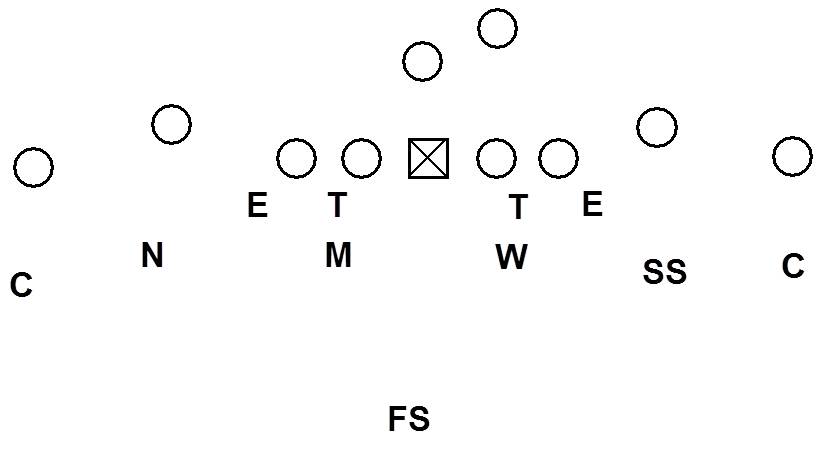
Here is an interesting concept from legendary Titans' Defensive Coordinator Dick LeBeau. The Titan's are a base 3-4 structure. However, they very rarely look like the 3-4 diagrammed below.


The Titan's use their base personnel against run heavy personnel groupings.


Often against these formations the 3-4 reduces the front, playing the OLB's at the LOS to create the under front and other base defensive structures.

Against spread formations with 10 or 11 personnel the Titans will sub to a Nickel or Dime package. 


While it may look like the normal 4-2-5 defense there are some differences. In the NFL most of the 3-4 teams sub out the Nose for the 5th DB. The DT's in this diagram are the ends in the base personnel grouping while the Ends in this package are stand up OLB's. Subbing into a 4 man line nickel package does have a some limitations. One being the defense can't bring 3 down odd front pressures from an even front.

The Titans have a solution.

Tennessee is using the sub nickel package but bumping the front to create an odd front look. This concept allows the defense to bring pressures like:


The Rush:
Mike & Will - Contain
End & Tackle - Long Stick to A Gap
End - B gap blitz
Tackle - Jap then loop to B gap

This is an America's Blitz variation. The twist action of the long stick DT with the looping zero technique creates an America's blitz effect on both sides of the formation.

The Coverage:
Man Free with the rushers covering the RB if the RB attempts to block them.


The offense has the numbers (6 vs. 6) to block the rush.


The left side (blue) picks up the pressure exactly as expected. The right (red) side is where the breakdown occurs. The guard is expecting the Center to be occupied with the zero technique. The guard sets out the B gap rush threat (either the Tackle or Will). When the Tackle long sticks the OG doesn't know initially if he will get help from the Center.


The Center squeezes the protection to the long stick DT when the zero technique loops. The guard locks on the long stick and realizes too late he needs to redirect to the looping zero technique. By the time the guard reacts the looping zero technique is through the B gap and pressuring the QB. 

The Titans found a create way to bring odd front pass rush from an even front personnel. The usage of the Zero and 5 tech on a twist that plays out like America's blitz is also creative. This concept is a good way to get the zero technique a better pass rush option. Often an odd front nose is forced to fight through a center from a head up alignment. The Center often has protection help from one or both of the guards. In that environment, pass rush opportunities can be tough to come by for a zero technique. Creating rush opportunities for the zero technique to use athleticism is a good change of pace from simply asking him to bull rush the mid-line and push the pocket. 

Saturday, November 21, 2015

4-2-5 Basics: Run Fits vs. 2 Back Formations

People often ask me about how we fit the run in the 4-2-5. They say things like:


"4-2-5 is just a 4-4 with DB's at OLB, so you just fit the run like a 4-4?" or
"4-2-5 is just a 4-3 using nickel sub personnel on every play, so you fit like the 4-3?"

My answer is "Yes" to both. Part of the reason the 4-2-5 is popular is that it can fit the run like a 4-4 or like 4-3. Teams can tailor the fits to their needs. Take for example a basic two back 21 personnel pro formation.


The defense can align and fit the run like a 4-4. The SS and WS play force while the four down linemen and two inside linebackers account for all the interior gaps. 

OR

The defense can choose to fit the run like a 4-3 with a safety filling the role of the third linebacker.

In this example the defense bumps the linebackers (Mike & Will) strong and bumps the WS into the box in the role of the third linebacker. Against a strong or weak flow running play the Mike, Will, and WS fit the run like a Sam, Mike, and Will in a traditional 4-3 defense would fit.

Versus a strong flow run


Versus a weak flow run

The defense can alternatively choose to bump the SS into the box and the linebackers weak. The SS, Mike, and Will then fill the role of the three linebackers.

Versus a strong flow run


Versus a weak flow run

Lastly, the defense can drop the FS down into the box to fill the third linebacker role.

Versus a strong flow run


Versus a weak flow run


How can a defense use this multiplicity? 

Take for example:


Here is a standard Iso or Lead play from a 21 personnel Pro I formation. If the defense chooses to fit this play like a traditional 4-4 defense, it can become a stress play.


In this scenario the Mike LB fit the FB on the outside half. If the inside linebackers are expected to bracket the fullback, the Will has a difficult job. The Will needs to align wide enough to keep leverage on the guard in case the offense is running an outside flow run weak, like outside zone. This prevents the Will from cheating his alignment too far inside. The result is the Center and Guard can scoop the Nose up the Will, potentially cutting the Will off from his bracket responsibility. 

One alternative solution is to have the Mike spill the fullback.


The Will LB's job is easier because he doesn't have to bracket the FB with the Mike. The new challenge is if the Mike is fitting inside of the fullback's block, who is fitting outside? The offense has a good angle to use the TE to block the SS from folding into the box. That leaves the FS. The FS can make the tackle but not without issues. The RB vs. FS may be a bad match up.  The FS may have to make an open field tackle vs. a full speed RB. Requiring the FS to be hyper aggressive to fit the run also opens up play action risks.

Neither fitting the Mike inside nor outside of the fullback may be optimal for the defense.

Some coaches may say:
"The DT needs to squeeze the guard's block and reduce the A gap."
"The Nose needs to control the scoop block, keeping the offensive lineman on the line of scrimmage longer. That buys time for the Will."
"The Mike needs to be violent and jam the fullback back in the hole."
"The Will needs to read his key and be quick to attack the ISO."

These are all true. The issue is that may be easier said then done. Especially when playing good teams. If you want to compete for conference and post-season titles you are going to have to play and beat good teams. What is the solution when their fullback is better than your Mike? What if the guard is getting movement on the DT consistently? Being able to change how the defense fits the run can help give the defense solutions to these problems.

Here the defense bumped the linebackers strong and is using the WS as the third LB.


With the Will bumped over the Center the Mike and Will have much easier time bracketing the fullback's block. The offense does not have an easy angle to block the Mike or Will.

More examples:

When the offense is using an offset fullback or an unbalanced set, the defense can sure up run fits by bumping to a 4-3 run fit.

Having the linebackers bumped can help get players to the point of attack. The offense most likely wants to run toward the offset fullback. It makes sense to get extra defenders where the offense wants to run the ball.


Here is an unbalanced formation. The offense most likely wants to run toward the unbalanced side. Being able to bump to a 4-3 run fit can help the defense remain gap sound even against the extra gaps created by the unbalanced formation. TCU coach Gary Patterson wrote about the concept of bumping in the 4-2-5 in his article for Nike Coach of the Year. On pages 6,7,8 of the article Coach Patterson explains TCU's slide and scoot concepts. 

There are other times when the defense wants to fit like a 4-4.


Here the defense is in a 4-3 run fit. If the offense is running a read power to the weak side the defense may have difficulty. The WS has a poor angle to force the wide path of the lead blocker. If the End steps down with the down block of the OT, the Will LB ends up in a 1 on 1 foot race with the RB. This may be a bad match up. 


If the defense is fitting the run like a 4-4, the angles are much easier for the defense. The WS has a natural force leverage from width on the lead blocker. The Will LB can much more easily scrape over the top of the DE and pursue the RB. 

The 4-2-5 has the added advantage of disguise. On any play the LB's could bump during the cadence. Any of the three safeties could move into the role of the third linebacker. The defense can also show a 4-3 fit and bump back into a 4-4 run fit. The result is offenses being forced to constantly identify, communicate, and react to a defense changing it's run fits.

The versatility and flexibility are major contributing factors in the success and popularity of the 4-2-5. I'm going to continue the Basics of the 4-2-5 series this off-season as I have time. If there is anything you would like to see, drop a comment or send me an e-mail.


Saturday, July 11, 2015

4-2-5 Quarter Quarter Half Coverage vs. Trips Routes

This post is a follow up to the Quarter Quarter Half trips adjustment post. This post focuses on the 1/4 1/4 1/2 coverage vs. some common 3x1 strong side routes.

Quick Game


The Corner is reading the QB for quick game. Against a hard shoulder action to the flat the Corner will trigger to #1's quick game route. The SS has #2's quick game and the Mike has #3.


The Corner will handle the outside vertical, squeezing the route into the sideline. The SS will handle #2's quick game. The Mike will handle #3's quick game.


The Mike will handle #3 on the quick game. The SS has #2's quick game which is the sit route by #1 on the quick exchange by #1 and #2. The corner will trigger on the QB's hard shoulder to the flat. The goal is to force the long throw to the flat where the corner should make the play.


Drop Back Passes

#3 is out so the Corner squeezes to #1 in his quarter. The FS is squeezes #2 in his quarter. The SS collisions #2 until he gets a "Push" call from the Mike. The SS pushes from Seam to Curl and breaks to the flat. The Mike expands looking for work. If #1's stays wide the SS covers both the curl and the flat route. If the curl works inside the Mike covers it.


#3 is out so the Corner squeezes to #1 in his quarter. The FS squeezes #2 in his quarter. The SS collisions #2 until he gets a "Push" call from the Mike. The SS pushes from Seam to Curl and breaks to the flat. The Mike expands looking for work, finding the inside curl. The SS must high low the curl to the flat.

#3 is out so the Corner squeezes to #1 in his quarter and should expect NO help on the post. The FS squeezes #2 in his quarter. The SS collisions #2 until he gets a "Push" call from the Mike. The SS pushes from Seam to Curl and breaks to the flat. The Mike expands looking for work, finding the inside curl. The SS must high low the curl to the flat. If the FS sees the Mike is expanding to cover the curl the FS can man turn and undercut the post.


#3 is vertical so the Corner plays the deep outside 1/3. His vision snaps to the outside receivers to find vertical threats. When #1 breaks his route short the Corner should make a "China" call. The Corner covers #2 on the corner route. The FS plays the middle 1/3 and squeezes #3's vertical. The SS collisions #2 until he gets a "China" call from the Corner. The SS immediately expands to the flat on a China call. The Mike drops underneath and inside the #3 vertical, collision if possible. 


#3 is out so the Corner squeezes to #1. With #1 releasing inside immediately the Corner will zone his quarter and cover #2's corner route. The FS squeezes #2 in his quarter and covers #2's corner route. The SS collisions #2 until he gets a "Push" call from the Mike. The SS pushes from Seam to Curl and breaks to the flat. The Mike will expand looking for work, finding the sit route by #1. 

#3 is vertical so the Corner plays the deep outside 1/3. His vision snaps to the outside receivers to find vertical threats. With no vertical threat the Corner zones his 1/3. The FS is playing the middle 1/3 and squeezes #3's vertical. The SS tops #2 playing in the window of the curl and breaking late to the flat. The Mike drops underneath and inside the #3 vertical, collision if possible.

#3 is vertical so the Corner plays the deep outside 1/3. His vision snaps to the outside receivers to find vertical threats. With 2 vertical threats the Corner midpoints the 2 verticals favoring the inside vertical. The FS plays the middle 1/3 and squeezes #3's vertical. The SS collisions #2 and gets depth in the seam with his head on a swivel. The SS expands to #1 if #1 converts his vertical to a comeback. The Mike drops underneath and inside the #3 vertical, collision if possible.


#3 is out so the Corner squeezes to #1 in his quarter and should expect NO help on the post. The FS squeezes #2 in his quarter and covers #2's out route. The SS collisions #2 until he gets a "Push" call from the Mike. The SS pushes from Seam to Curl and breaks to the flat. There is no curl but by pushing to the curl area the SS is underneath the out route by #2. The Mike will expand looking for work.

Screens

#3 is out so the Corner squeezes to #1 in his quarter. Once the corner snaps his eyes to #1 the #1 receiver is blocking. The corner will shed #1's block and secure the sideline. The FS squeezes #2. Once the FS snaps his eyes to #2 the #2 is blocking. The FS will run the alley inside the SS. The SS sheds #2's block and will force the bubble with outside in leverage. The Mike will expand inside out caging the ball with the SS.


#3 is out so the Corner squeezes to #1 in his quarter. Once the Corner snaps his eyes to #1 the #1 receiver is chopping his feet and selling a block. The Corner may react but by having his eyes on #1 allows him to collision and run with bubble & go. The FS squeezes #2. Once the FS snaps his eyes to #2 the #2 is chopping his feet and selling a block. The FS may react but by having his eyes on #2 allows him to collision and run with the bubble & go. Film study will help the Corner and FS identify the difference between bubble vs. bubble & go. 


#3 is blocking so the Corner plays the deep outside 1/3. His vision snaps to the outside receivers to find vertical threats. With no vertical threats the Corner triggers to the screen and secures the sideline. The FS triggers and runs the alley inside the SS. The SS triggers straight up the field. If the SS gets any width he will get kicked out by the OL. By triggering straight upfield the SS either makes the tackle by beating the block of the OL or forces the ball to bounce over the top back inside to the rest of the defense. The Mike will expand inside out caging the ball with the SS.
#3 is blocking so the Corner plays the deep outside 1/3. His vision snaps to the outside receivers to find vertical threats. Once the Corner snaps his eyes to the outside receivers where #2 is chopping his feet and selling a block. The Corner may react but by having his eyes on the outside receivers allows him to collision and run with screen & go. The FS may trigger on #3's "block" but by having his eyes on #3 allows him to collision and run with the screen & go. Film study will help the Corner and FS identify the difference between wide screen vs. screen & go. 


Friday, July 10, 2015

Defending Trips with Quarter Quarter Half Coverage in the 4-2-5

This is the first post in a series about trips coverage adjustments. This is a 1/4 1/4 1/2 concept.


The Corner to the Trips is using Rattle technique. Rattle stands for Read Three. Corner is aligned 1x7 inside of #1 tilted. He is reading QB for quick game to #3.

The FS is also using Rattle technique (reading #3). The FS is aligned at 10-12 splitting the difference between #2 and #3. His initial footwork is a controlled pedal.

Rattle Technique


If #3 releases outside the FS will squeeze his coverage to #2, while the corner will squeeze outside to #1.


If #3 releases inside or vertical the FS will work to the middle 1/3 and the corner will squeeze #2 in the seam playing the outside 1/3.

SCiF Technique

The SS is aligned at 5 yards outside shoulder of #2 with a square stance. On the snap the SS will pop his feet and read through the EMLOS to the QB. His drop is SCiF (Seam-Curl-Flat). The SS has quick game routes to #2.

Against drop back pass if the #2 releases vertical the SS will stay square and collision #2. After collision the SS will pedal to a depth of 12 in the seam (2 yards outside the hash). 


While pedaling the SS will have his head on a swivel looking for the QB and receiving threats. If the QB tries to throw the ball on a line to #2 in the seam the SS should be able to make the play.

The SS will expand to the Curl and Flat if necessary.

If the #1 receiver is running a curl or in the SS should expand to cover him. The SS will only know to expand if he keeps his head on a swivel while pedalling. Also the Corner should give the SS an "IN" call.


If the #3 receiver is releasing outside the 3RH dropper (here the Mike) makes a "Push" call. The "Push" call pushes the SCiF dropping SS from Seam to #1's Curl and he should be ready to break to the Flat on the throw.


If #2 is inside immediately the SS will make an "Under" call and get depth in the seam.


If #2 is outside immediately the SS will top the flat route expanding from the Seam to the Curl and breaking on the throw to the flat.


3RH Technique 

The Mike is a 3 Receiver Hook (3RH) dropper and drops in relationship to #3. The Mike has quick game routes to #3.


If #3 is out immediately the Mike pushes the SS and expands looking for a route to cover coming back inside.


If #3 is inside immediately the Mike walls #3. We rarely see #3 running a route deep enough to wall. Typically the #3 is running very shallow. If the #3 is under 5 yards the Mike calls "Under" and gets depth to 12 with his head on a swivel for new routes entering his zone. The Mike can pass the under because the Will is in the weak Hook-Curl and should be ready to break and tackle any throw to #3 on the under.


If #3 is vertical the Mike collisions #3 if possible and will work to a max depth of 12. If #3 is vertical there will be a middle 1/3 safety so the Mike does not need to carry #3 vertical down the field.

If #3 tries to work to the backside hash the Mike will wall him. The Will is in the weak Hook-Curl to force the ball over the top where the FS and the backside Corner should have a play on the ball.

Those are the strong side drops. The next post will focus on Rattle coverage vs. common 3x1 strong side route combinations.